
Indian start-ups breathed a sigh of relief after the UK government facilitated the acquisition of the now-defunct Silicon Valley Bank's (SVB's) British arm by HSBC. In a bid to allay fears, the US Federal Deposit Insurance Corporation (FIDC) announced recently that it had transferred all deposits of start-up-focused SVB to a newly created bridge bank and all depositors would have access to their money. President Joe Biden also sought to reassure jittery depositors that they can have confidence that the US banking system is "safe".

Even as you fight the ongoing health challenge, here are some tips to strengthen your personal finance in the time of coronavirus.

With the Swiss government showing eagerness to help India trace suspected black money hoarders, banks based in Switzerland appear to be losing traction among the wealthy Indian clients and could not get much business commitments during the just-ended WEF summit.

On November 12, 2021, the Reserve Bank of India (RBI) decided to ring in uniformity in asset classification and income recognition across all lending institutions. Shadow banks, or non-banking financial companies (NBFCs), like commercial banks, are to test non-performing assets (NPAs) on a daily basis and upgrade them to "standard assets" only when interest and principal arrears are settled by borrowers. This is going to create all manner of headaches for shadow banks and their clientele. Says Y S Chakravarti, managing director and chief executive officer (CEO), Shriram City Union Finance: "NPA levels will go up, especially of small borrowers.

Alternative investment funds (AIFs) have not seen any significant redemptions from financial institutions even though the 30-day timeline provided by the Reserve Bank of India (RBI) to liquidate their holdings or make full provisions ends recently. Sources said the industry is awaiting certain relaxations or extensions based on the recommendations submitted to the banking regulator. On December 19, the RBI restricted financial institutions and banks from investing in AIFs where there is any downstream link or exposure to a debtor firm.

The idea that India is the world's largest democracy is a complete lie, Rahul Gandhi alleged.

IPO-bound mobility platform Ola, said it has successfully raised $500 million via a Term Loan B (TLB) from marquee international institutional investors. This term loan has no impact on the valuation of Bhavish Aggarwal-led Ola. The Bengaluru-based firm recently raised $139 million. This is part of a $1 billion funding round for which the company is in talks with investors, increasing its valuation to about $7.5 billion, according to the sources.

Among major Sensex movers, ITC rose the most by 1.70 per cent, Wipro by 1.43 per cent, Tech Mahindra by 1.36 per cent and Nestle India by 1.27 per cent. Other gainers included HCL Tech, Asian Paints and Reliance. On the other hand, ICICI Bank, NTPC, UltraTech Cement and Tata Steel traded with a loss of up to 0.82 per cent.

'Das is friendly, but he finally does what he does. The quality of engagement is very good.'

From the 30-share pack, Indusind Bank, Axis Bank, Maruti Suzuki, Bajaj Finance, Bajaj Finserv, UltraTech Cement and Mahindra & Mahindra were the biggest drags, tumbling up to 7.63 per cent.

A paper authored by Rajan said, state-linked banks can be a first step in altering the ownership structure of some PSBs, where the government brings down its stakes to below 50 per cent, creating distance from operations of banks, and improving governance along the way.

Among the Sensex firms, Maruti, NTPC, Tata Motors, ICICI Bank, HDFC Bank, Reliance Industries, JSW Steel, ITC and Mahindra & Mahindra were the major laggards. Bajaj Finance, Larsen & Toubro, Bajaj Finserv and Titan were among the gainers.

All banks are eligible for privatisation. A committee of secretaries will decide which banks will be privatised, says Financial Services Secretary Debasish Panda.

Anil Agarwal-owned Vedanta Resources (VRL), which has hired Standard Chartered Bank to raise funds for its Konkola copper mine assets, says it is engaging with several potential partners for both short-term funds and long-term equity financing for the Zambian project. A Vedanta official said its commitment to optimising capital allocation and driving expansion is a key cornerstone of its strategy for the mines. It will enhance value creation and operationalise the Konkola Copper Mines (KCM).

'Unfortunately, most of our students use AI to replace knowledge when they should be using the AI tools to enhance their knowledge.' 'I am sorry to say, even those students who have opted to study AI have no idea what AI is.'

From the Sensex basket, Tata Consultancy Services, Nestle, Bajaj Finserv, Wipro, Maruti Suzuki India, Reliance Industries, Larsen & Toubro and NTPC were the major laggards. Tata Steel, Bajaj Finance, JSW Steel and Bharti Airtel were among the gainers.

The home loan top-up, a kind of secured multipurpose personal loan, is on the regulator's radar, points out Tamal Bandyopadhyay.

Indian FIs are fast getting their act together to counter stiff competition from the banking entities.
Terming India's fiscal decentralisation as 'flawed', the World Bank has mooted six broad strategies, including strengthening the state finance commissions, broadening tax base and greater devolution of power to Panchayati Raj institutions.

Capital markets are becoming more prominent in India's growth story, with an expanding share in capital formation and investment landscape on the back of technology, innovation and digitisation, according to the Economic Survey 2023-24 tabled in Parliament on Monday. Further, Indian markets are resilient to global geo-political and economic shocks, it added. "Despite heightened geo-political risks, rising interest rates and volatile commodity prices, Indian capital markets have been one of the best performing among emerging markets in FY24," the Economic Survey said.

Private equity (PE) is set to play a bigger role in banks. Of 21 recommendations accepted by the Reserve Bank of India (RBI) out of 31 made by its Internal Working Group (IWG), its stance on non-promoter holdings in private banks is seen with excitement, though it doesn't refer to PEs explicitly. On non-promoter holdings in these banks, the RBI said this will be capped at 10 per cent of the paid-up voting equity share capital in the case "of natural persons and non-financial institutions and entities"; and "at 15 per cent for all categories of financial institutions, entities, supranational institutions, public sector undertaking, or the government." While this is a modification of the IWG's stance for the non-promoter holding in banks at up to 15 per cent, it does open up a huge window for PEs, all the same. This is because, while the RBI has remained silent on the eligibility of industrial houses for bank licences, fresh high-quality capital in large amounts can only come from PEs.

The message is clear: The 60-year-old wise uncles need to handhold the 40-year-old entrepreneurs when, obsessed with ambition and greed for growth, they become a victim of hubris, points out Tamal Bandyopadhyay.

Thanks to the recapitalisation by the government and measures taken by the central bank, collapse of any large housing finance company won't pose as big a risk as it had six months ago.

ETFs function like a mutual fund scheme and have underlying assets of government-owned companies.

India is among 75 countries with which Switzerland's Federal Tax Administration has exchanged information on financial accounts within the framework of global standards on Automatic Exchange of Information.

Key stock indices Sensex and Nifty declined over 1 per cent at close on Monday due to heavy selling in banking, auto and FMCG shares amid weak global market trends and continued foreign fund outflows. Reversing its previous session's gains, benchmark BSE Sensex tumbled 638.11 points or 1.11 per cent to settle at 56,788.81. During the day, it tanked 743.52 points or 1.29 per cent to 56,683.40. The broader NSE Nifty fell by 207 points or 1.21 per cent to end at 16,887.35 as 42 of its constituents declined.

India's unabated tryst with Russian crude oil is slowly coming to an end. The time has come for Indian refiners to navigate, creatively, the choppy waters of the post-honeymoon period, and for Indian policymakers to take cognisance of the broader impact on India from the spillover of the Russian crisis - after Washington's warning to transgressors last week. Shipments from Russia to India have averaged over 1.8 million barrels a day since February, according to data from Paris-based market analytics firm Kpler. But much of the crude shipped to India was non-sanctioned because it traded below a price cap set by the US led G-7 nations in December.

Sun Pharma, Bajaj Finserv, Tata Consultancy Services, Infosys, Hindustan Unilever, JSW Steel, Wipro, Maruti, HCL Technologies, Tech Mahindra and ICICI Bank were the other major gainers. State Bank of India, Tata Motors, Axis Bank, Kotak Mahindra Bank, Bajaj Finance, Tata Steel, Nestle and HDFC Bank were the laggards.

Finance firms in these SEZs likely to get tax breaks.

The microfinance vertical of the bank will provide loans of Rs 80,000 to Rs 1,00,000.

Notwithstanding the recent sharp decline in the stocks of public sector companies, analysts at Jefferies remain bullish on this segment. State Bank of India, Coal India, and NTPC are their top picks in this space, they said in a recent note. The public sector undertaking (PSU) or state-owned enterprise (SOE) index, with a 70-percentage-point outperformance versus the National Stock Exchange Nifty50 over the past 12 months, comes after a decade of underperformance before 2020.

Life has come full circle for Nobel laureate Professor Mohammad Yunus, who faced persecution during Sheikh Hasina's regime for embezzlement, is now all set to head of the interim government in Bangladesh after she resigned and fled the country.

Experts say the recent Rs 14,000-crore PNB fraud could have been avoided had there been an integration of PNB's CBS with its SWIFT system

'The prime minister's comment on 'revdi culture' was welcome. But I am disappointed he did not follow up on that.' 'All political parties, including the BJP, have been guilty of this.' 'Now, Modi's guarantees, the Congress's 'nyay' path and both ruling and Opposition parties are vying with each other for freebies in my home state Andhra Pradesh.'
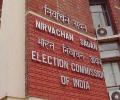
The Election Commission (EC) had, in 2019, flagged its concerns in the Supreme Court on the changes made in several laws relating to political funding to facilitate the electoral bonds scheme, saying it will have 'serious repercussions' on transparency.

The sector faces many challenges and calls for prompt corrective action.

YES Bank, Bank of Baroda, SBI, IndusInd Bank, and RBL Bank are amongst the banks, Jefferies says, are most prune to "high risk" emanating from ADAG, Cox & Kings, CG Power, DHFL and Essar Shipping.

Why do we need a bad bank, owned by the banks themselves when there are at least 28 ARCs around, asks Tamal Bandyopadhyay.

Among the Sensex firms, Hindustan Unilever, Tech Mahindra, Infosys, Reliance Industries, Bajaj Finance, Tata Consultancy Services, Titan and UltraTech Cement were the major laggards. Mahindra & Mahindra, Power Grid, IndusInd Bank, Tata Motors, Larsen & Toubro and Maruti were among the gainers.

Among the Sensex firms, Bajaj Finance jumped the most by 4.64 per cent. Bajaj Finserv, Kotak Mahindra Bank, Asian Paints, UltraTech Cement, ICICI Bank, NTPC, JSW Steel and Tata Steel were among the major gainers. Infosys, Mahindra & Mahindra, Wipro, Tata Consultancy Services, IndusInd Bank and HCL Technologies were the major laggards.
 © 2026 Rediff.com - Advertise with us - Disclaimer - Privacy Policy - Sitemap - Feedback - About us - Terms of use - Grievances